Sunday, February 13, 2011

Battlefield: Earth

The New Yorker has an incredible article that profiles Paul Haggis and the Church of Scientology. This has got to be the longest New Yorker piece ever... at least the longest I've read. I got held on the F train for a little over an hour (for a trip that is usually but 35 minutes) and that still wasn't enough to get through the whole thing. But the length is worth it, as it is quite in-depth and engrossing, and hard to put down.
Scientology is fascinating because there is so much uncertainty about what exactly it is, what it's belief system entails. And the troubles the religion finds itself with are usually because the church tries to keep things hidden and mysterious, but is also constantly trying to clear up the misunderstandings that it wants straitened out. This comes across as disingenuous, especially when you then read about the people in the piece who have left the faith, and whose word was considered credible when they were Scientologists but are now considered liars.

Wednesday, December 29, 2010

Was I better today than yesterday?

I enjoyed these words of wisdom from Daniel H. Pink's Drive. In general, asking questions of yourself and of the world is better than placing demands and expectations, or trying to will the things you want.

Tuesday, December 14, 2010

Whatever Happened To Alternative Nation?

I've been following this great 6(so far)-part column in the AVClub about the writer's personal experience of grunge and alternative music in the 1990s, and how the music we like from that era now is not always the music we actually listened to at the time. It's easy to identify with the author: a lot of the music that broke out in the '90s was inescapable, but we'd all like to forget about it and and recognize the '90s music that we now respect. Hell, I used to live in Seattle, an entire city that operates on that notion. But these columns are warning that when you do that, you do miss out on some great music: it's time we also look at this music for its own worth and not just as part of the larger scene and era that produced it. With the proper distance, you can see the merits of each artist, and how each of the prominent grunge artists of the time had their own sounds and influences.

Monday, September 6, 2010

Covert Operations

I found this New Yorker piece on the Koch brothers, two major funders of libertarian think tanks and Tea Pary organizations, quite fascinating. I do wonder about the way that the Kochs are set up in this article (could you write a similar article about any number of political financiers?), but there are many, many pieces of evidence presented that show their enormous power in shaping the political debate in this country. Among the many, these two stand out shockers stand out in my mind:

The David H. Koch Hall of Human Origins, at the Smithsonian’s National Museum of Natural History, is a multimedia exploration of the theory that mankind evolved in response to climate change. At the main entrance, viewers are confronted with a giant graph charting the Earth’s temperature over the past ten million years, which notes that it is far cooler now than it was ten thousand years ago. Overhead, the text reads, “HUMANS EVOLVED IN RESPONSE TO A CHANGING WORLD.” The message, as amplified by the exhibit’s Web site, is that “key human adaptations evolved in response to environmental instability.” Only at the end of the exhibit, under the headline “OUR SURVIVAL CHALLENGE,” is it noted that levels of carbon dioxide are higher now than they have ever been, and that they are projected to increase dramatically in the next century. No cause is given for this development; no mention is made of any possible role played by fossil fuels. The exhibit makes it seem part of a natural continuum. The accompanying text says, “During the period in which humans evolved, Earth’s temperature and the amount of carbon dioxide in the atmosphere fluctuated together.” An interactive game in the exhibit suggests that humans will continue to adapt to climate change in the future. People may build “underground cities,” developing “short, compact bodies” or “curved spines,” so that “moving around in tight spaces will be no problem.”

And this mini-expose on David Koch's relationship with the National Cancer Institute:

Scientists have long known that formaldehyde causes cancer in rats, and several major scientific studies have concluded that formaldehyde causes cancer in human beings—including one published last year by the National Cancer Institute, on whose advisory board Koch sits. The study tracked twenty-five thousand patients for an average of forty years; subjects exposed to higher amounts of formaldehyde had significantly higher rates of leukemia. These results helped lead an expert panel within the National Institutes of Health to conclude that formaldehyde should be categorized as a known carcinogen, and be strictly controlled by the government. Corporations have resisted regulations on formaldehyde for decades, however, and Koch Industries has been a large funder of members of Congress who have stymied the E.P.A., requiring it to defer new regulations until more studies are completed.

Koch Industries became a major producer of the chemical in 2005, after it bought Georgia-Pacific, the paper and wood-products company, for twenty-one billion dollars. Georgia-Pacific manufactures formaldehyde in its chemical division, and uses it to produce various wood products, such as plywood and laminates. Its annual production capacity for formaldehyde is 2.2 billion pounds. Last December, Traylor Champion, Georgia-Pacific’s vice-president of environmental affairs, sent a formal letter of protest to federal health authorities. He wrote that the company “strongly disagrees” with the N.I.H. panel’s conclusion that formaldehyde should be treated as a known human carcinogen. David Koch did not recuse himself from the National Cancer Advisory Board, or divest himself of company stock, while his company was directly lobbying the government to keep formaldehyde on the market. (A board spokesperson said that the issue of formaldehyde had not come up.)

James Huff, an associate director at the National Institute for Environmental Health Sciences, a division of the N.I.H., told me that it was “disgusting” for Koch to be serving on the National Cancer Advisory Board: “It’s just not good for public health. Vested interests should not be on the board.” He went on, “Those boards are very important. They’re very influential as to whether N.C.I. goes into formaldehyde or not. Billions of dollars are involved in formaldehyde.”

Harold Varmus, the director of the National Cancer Institute, knows David Koch from Memorial Sloan-Kettering, which he used to run. He said that, at Sloan-Kettering, “a lot of people who gave to us had large business interests. The one thing we wouldn’t tolerate in our board members is tobacco.” When told of Koch Industries’ stance on formaldehyde, Varmus said that he was “surprised.


Saturday, August 28, 2010

All that Jazz

I liked this NYTimes piece about the jazz scene in Seattle, and how it is being well nurtured by programs in the city. I knew a few jazz musicians in Seattle but never knew much about the scene, though I'm happy to hear that it's thriving.

Tuesday, August 24, 2010

Another reason to soak the super-rich...


Former eBay CEO Meg Whitman has spent $91 million of her own money on her campaign for governor of California... that's just disgusting. But I don't know what's worse: that she can essentially buy her way into an elected spot, or that despite the spending so much, she's still going to lose.

Sunday, August 22, 2010

There's one for you, 19 for me


Sorry George, though so much of the Beatles' work is equal in my eyes, this short New Yorker article make the case that not all of the rich are equal to one another, and that we need a tax system that reflects that.


Sunday, February 7, 2010

Four things about Google's Super Bowl ad:

1. I did like it, it shows how search engines play important parts in our lives, and it is interesting to see how a story can be told with just the search queues.

2. Despite that, it seemed very similar to the montage (spoiler!) at the beginning of Pixar's "Up," so its not too original in my opinion.

3. It makes me think of this interesting and entertaining contest from Slate last year.

4. I've started working on a parody/sequel of it where it turns out the kid is not his. It shouldn't be too difficult to put together, i don't think.

Saturday, February 6, 2010

High Impact Sports

David Brooks has a pleasant piece in the NYTimes about the different eras of sports, and how our current era reflects the earlier ones. I like his conclusion about how rooting for your favorite team cuts across many lines of division and brings people together. I agree with this, and its one of the reasons I admire sports and athletics. I love the ideas of cooperation within a team and competition between teams. I also liked Brooks’ mentions of how we form much of our morals and sense of fairness from sports.

Though I enjoyed Brooks’ article, I can’t help but think that football isn’t the best sport that to use in this case. Sure, it does illustrate very well the loyalty and devotion to the team that Brooks wants to show. But, as Malcolm Gladwell points out in this New Yorker piece from late last year, football is, if not like the coliseum death matches that the Roman government sponsored, a lot like dogfighting.

Gladwell comes to this conclusion from his investigations into the head injuries that many football players are afflicted with. Reading the article, you will find that while a player may not suffer a serious head injury on the field, he will be impacted brain problems later in life from the many blows he has taken on the field. This article in the NYTimes also addresses this issue.

Aren’t sports supposed to make us healthier and to improve our bodies? That’s why I partake in the sports, and why I admire my favorite athletes and team. But the retired football players with scar tissue in their brains certainly don’t seem to fit this vision of an athlete. And most of us are blind to the damage that is going on. As this Freakonomics podcast notes, there hasn’t been an on-field deaths in the NFL, but football players do die on the field in other leagues and also suffer later in life the serious consequences of continuous blows to the head. By not seeing these injuries or being shocked into a changed attitude, we don’t see this as a problem, and we are implicitly giving reassurance that football and similar contact sports are safe.

In addition, this Freakonomics podcast also looks at this by investigating the safety of football helmets. In turns out helmets are great at absorbing a hit and preventing the player from being knocked out cold. What they don’t do anything about are the cumulative effects of being hit in the head over and over again, and there most likely won’t be a helmet that will do that.

This hypothesis in the Freakanomics podcast also makes me think of the recent attention to barefoot running. As Barefoot Ted remarks in this interview, while wearing conventional running shoes, runners are more likely to overstride, causing more impact because of the cushioning that the shoe provides. This leads often to injury and imbalance when running. While this may not seem as serious as the consequences of brain injuries, it does present the same point that the feeling of safety may actually encourage risks, and the negative results of those risks accumulate over time and impact you in a way that you could not have foreseen.

Tomorrow is the Super Bowl, and I am still going to watch this Sunday’s big game, and I will continue to root for the Wolverines every Fall, but I will also keep aware of any new findings and hoping that steps are taken, no matter how necessarily drastic those steps may have to be.

Tuesday, November 17, 2009

the difference between compromise and surrender

I recently received an email about how Sen. Barbara Boxer will go against the Stupek Amendment in the health care bill when it comes to the Senate. So is the Stupek Amendment something to fight against, or is it just a necessary compromise in a Democratic Party that is a “big tent” that wants to achieve one goal that all Democrats can agree on: health care reform?


Jeffrey Toobin’s editorial in the New Yorker is a great analysis of the role of abortion in the health care debate. He explains how the Stupek Amendment will affect the health insurance exchanges that will be set up and eventually lead to insurance plans that will not cover abortion services, which virtually all insurance plans currently do. (I wonder, if the Stupek Amendment goes through and passes along with the current health care bill, can’t it just be ruled, eventually, as unconstitutional? Perhaps, but even so, that may depend on the makeup of the Supreme Court.) I especially liked Toobin’s remark about the lobbying for the amendment by the Catholic bishops, who never seem to be so politically involved in other issues that go against church teaching (like massive incarceration, the death penalty, treatment of the poor, environmental justice, just to name a few of many). You do have to give them credit for being for health care reform; they just want it on their own terms.


But the fact is that Democrats are trying to represent the viewpoint that we need a strong government hand in health insurance, but that those who can agree on that may not agree on other issues, like abortion. Another article, from the Daily Beast, which overall I find flawed, nonetheless gives one something to think about when it comes to “Big Tentism:” with the Republican Party representing fewer and fewer people and viewpoints, the Democrats are in a better position to recruit more people with more viewpoints, and in fact have done this by intentionally recruiting anti-choice Democrats to run for office. So as Toobin and the Daily Beast article point out, what’s the price of this? The Daily Beast article paints it as a necessity to get things done and move on with very big, progressive reforms, while Toobin encourages us to rethink that.

Saturday, November 14, 2009

Health Care Bill Does Not Mean Progress

My initial joy over the health care bill passed by the House has waned considerably. We all knew we wouldn’t get exactly what we wanted, that there’d be a lot of compromise, but I thought most of that would be in the form of compromising with insurance companies over profits—not that the health needs of half of the people in this country would be purposefully neglected. It’s not just the anti-abortion Stupak amendment that I am referring to, but the lack of coverage even for birth control. Apparently it’s not just pregnancy that is a preexisting condition, but so is just having a womb.

And why the hell is the Catholic Church involved in writing bills at all, but especially writing bills that that are relevant to women’s health? There are no women in the leadership of the Catholic Church, and it is set up so that their can never be; and I can only assume that the leadership is has no realistic knowledge of the female body, seeing how the body of its most beloved female figure is treated as a magic vessel rather than an actual biological person. This does not make the Catholic Church even remotely and advocate on behalf of women, let alone an authority on the women’s health issues.

Passing this health care bill seemed like progress for this country, and I felt extremely proud when it passed. It made me happy to have representatives who were finally acting on the needs of the American people, and made me satisfied that the Democrats didn’t back down from health insurance reform. But it’s highly disappointing to have abortion yet again be the sticking point in a debate where it doesn’t belong, as well as having a health care bill that gives in to the continued social engineering of women’s bodies.

Monday, September 7, 2009

Athletes have rights?

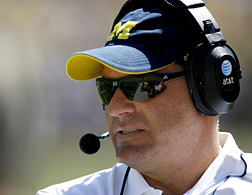
Michigan coach Rich Rodriguez

This short article from the great Slate talks about how the racial integration of college football teams shaped the current NCAA rules and restrictions on players. The author gathers that the outcome of such rules have swayed more power to coaches in the lives of college athletes. Recently, some anonymous Michigan Wolverine football players have reported that the program regularly schedules practice hours pasts the guidelines of the NCAA.

I'm proud of Michigan's football history and of having gone to a university with a student body that's progressive, intellectual, impressive, and knows how to enjoy itself and by not being down on athletic, particularly the football program. The last, I dunno, decade of Michigan football has been hard enough to go through, but we don't need a promising season this year to get derailed by unethical conduct... though their might be far more than enough evidence that that may be the case.

Sunday, September 6, 2009

We are not monkeys or cavemen


Though I am interested in evolutionary psychology and i think it has a lot to teach us about our behaviors, I really enjoyed this critique in Newsweek that particularly deals with the evolutionary psychology of rape.
To sum up the critique, evolutionary psychology takes a behavior that exists today, like rape, and says "This behavior must have survived because it was necessary for survival at one time." While that has truth to it, what the article points out is the social flexibility of the human mind, and that while some behaviors emerge for survival, they can then be weeded away if they become detrimental to survival. The article goes into why this is the case for rape, and gives one pause for why some make the case for the existence of other terrible human behaviors.

Thursday, January 29, 2009

A Hard Rain


I just listened to a local piece on NPR about why people consider Seattle home and why, according to a recent survey, many people who don't currently live here would chose to live here if they could. This, along with a few email correspondences recently and my "two year anniversary" at my job, has lead me to recognize just how much I've gained and grown since moving here, and it really hit me that it will be hard to to leave Seattle if or when I do. I think for the most part I've thought of Seattle as a pit stop, a place that I'll spend some great times in, and perhaps even come back to after trying some other places. But "pit stop" really belittles the experiences that I've had since moving here, as the gravity of me living here has cautioned in thinking that this is just one place of the many that I 
I think that from here on out, I will be doubly asking myself "Is this a good idea" or "Will this be a mistake" when I envision my next big move. I don't want to let that stop me from making an important and necessary step in my life when that comes, but I also need to recognize that making that decision won't be so fleeting as I would have thought not tool long ago.

Thursday, December 25, 2008

Mmm... cake

I'm pretty sure that I would also marry Sloan Crosley. Here she is at Google. Here's a funny episode of the Sound of Young America with her.

Sunday, December 21, 2008

Shocking!


The New Yorker has a recent profile of Naomi Klein. I haven't done much substantial reading of any of Klein's work, but despite that, I'm pretty sure I would marry her if I could.

Spreading the Social Gospel?

I must say that I'm still a bit conflicted about Rick Warren doing the invocation at Barack Obama's inauguration. Since I'm not that all religious, one part of me thinks that there shouldn't be an invocation anyways. But I recognize the role religion plays in many lives and in American society, so with that assumption, what does it mean to have Rick Warren give the invocation? I wouldn't want someone playing an important part in the inauguration to be a bigot in any way, be it anti-gay, anti-black, anti-Catholic, anti-Semetic, and so on. So what would be the reason to have Rick Warren there, who has made comparisons between gay marriage and incest?

I enjoyed reading Juan Cole's recent take on Warren, where Cole showed that in many ways, Warren is not the typical evangelical bigot. He bases his teachings on personal betterment and preaches a compelling social Gospel has been neglected from many religious teachings in recent years. 

Furthermore, if Barack Obama were a conservative Republican and picked Warren, then you could easily read into it as giving support to Warren's anti-equality views. But Obama obviously didn't pick him for that reason, or to give a wink to any particular political faction. I think that he did it in a sincere effort to bring people together (didn't he say once or twice or a million times while campaigning that he would be doing that?). I think what would be unfortunate with such gestures is that often they end up insulting many of your supporters while not meaning much to your political opposites. 

I think that in the end, this was a bad move, and I think that Rachel Maddow makes a good point: Obama's inauguration is to be a day that is a culmination of a long fight for equal rights in this country, so what's that guy who opposes equal rights for some people doing there?

Sunday, December 14, 2008

My "Bill Kristol is always wrong" theory gets challenged

Oh dear Lord, I never thought this would happen: I actually got through one of Bill Kristol's NYTimes columns without going nearly blind with rage. His one use of the phrase "political and media elites" notwithstanding, Kristol actually sums up a lot of my feelings on the current progress of the US auto industry bailout. The basic question of the article is: why the animosity towards the auto companies and its union? Kristol actually gives some accurate answers.

Wednesday, November 26, 2008

On the home front...

Originally, I thought Mitt Romney's NYTimes piece on the auto industry bailout was surprisingly realistic and reasonable. However, I find this piece from salon.com to be more on target. It recognizes the historical fact that Henry Ford and the industry he led helped to create the American middle class, along with the UAW, which rose standards for all worker, and made reality the idea that a factory worker could make enough to live the same quality of life as his company's management.

This piece gave me more perspective on the recent outsing of my former Congressman John Dingle from his commitee chairmanship; though Dingle can easily be portrayed as defending the auto industry at all cost, he has also been introducing legislation for univeral healthcare every year for the last half century. The fact is that Dingle cares about the people involved in the industry and the reprocussions that its failure would have, while someone like Romney doesn't.

I also like the point of view that the salon piece takes on the SUV boon of the last decade: though it is widely viewed as irresponisble, it was a way for the Big Three to countiue to live up to their obligations in the social contract.

Maximum Fun


Check out the work of Chip Kidd, who has designed book covers for the last 20 years or so. I saw him being interviewed at Bumbershoot this year at a taping of The Sound of Young America.